Our Livestock Guardians
Our journey towards llama ownership started with raising sheep. As a shepherd, you need either impenetrable fencing or a livestock guardian. Since the former is practically unheard of in farming, we opted for livestock guardians.
At first we had a donkey named Jenny. Jenny was doing a fine job, until one day, when I came out and found her gripping a sheep by the leg with her teeth and thrashing it around. So, I was lucky enough to be able to exchange her for a second donkey - Tinkerbell.
Well, Tink was also a great guardian. However, I soon afterwards added a horse, named Flicka, to the herd and Tink was sure she was a horse too, so she spent most of her time with Flicka instead of with the sheep. This sort of defeated the purpose of having her in the sheep pasture. As a result, we moved the equines out to another pasture and acquired some livestock guardian dogs.
Our guardian dogs were a beautiful Maremma, named Sadie and a Great Pyrenees, named Ceasar. Both were rambunctious dog, but took their jobs seriously and we never lost a sheep or a lamb. Sadly, we have one close neighbour - despite our 64 acres - who complained about the dogs barking to the point, in order to keep the peace, we rehomed the dogs. Happily, they went to a cashmere goat farm nearby and were able to fulfill their roles there.
Our herd boss and matriarchal ewe - Pearl

Tink and our horses

Jenny the donkey

Sadie and Ceasar

Aquiring a Llama
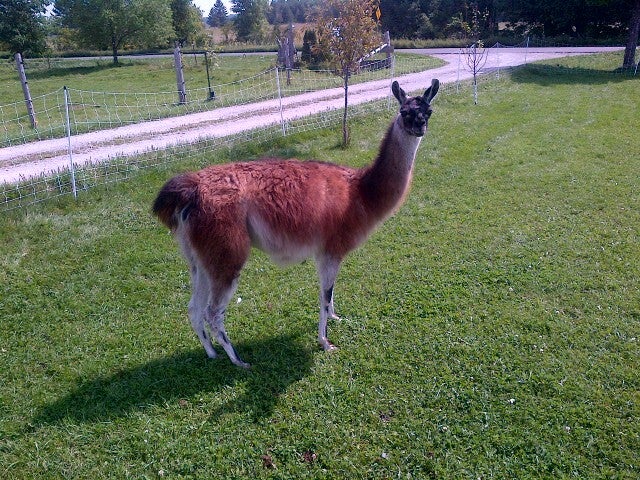
As I was surfing the internet for a replacement guardian, I came across an ad for a llama for sale in nearby Barrie. We hooked up the horse trailer and picked her up right away. We named her Dolly and put her right to work with the sheep. She was relatively tame, such that for one family reunions at the farm, we had her out on the lawn with the family, intermingling. She, like the dogs, did her job well and we sustained no sheep losses. Unfortunately, and for no apparent reason, Dolly just up and died one day; rule number one of farming is: livestock is deadstock. So, you can't get terribly attached to your farm animals for this exact reason.
A Second Dolly
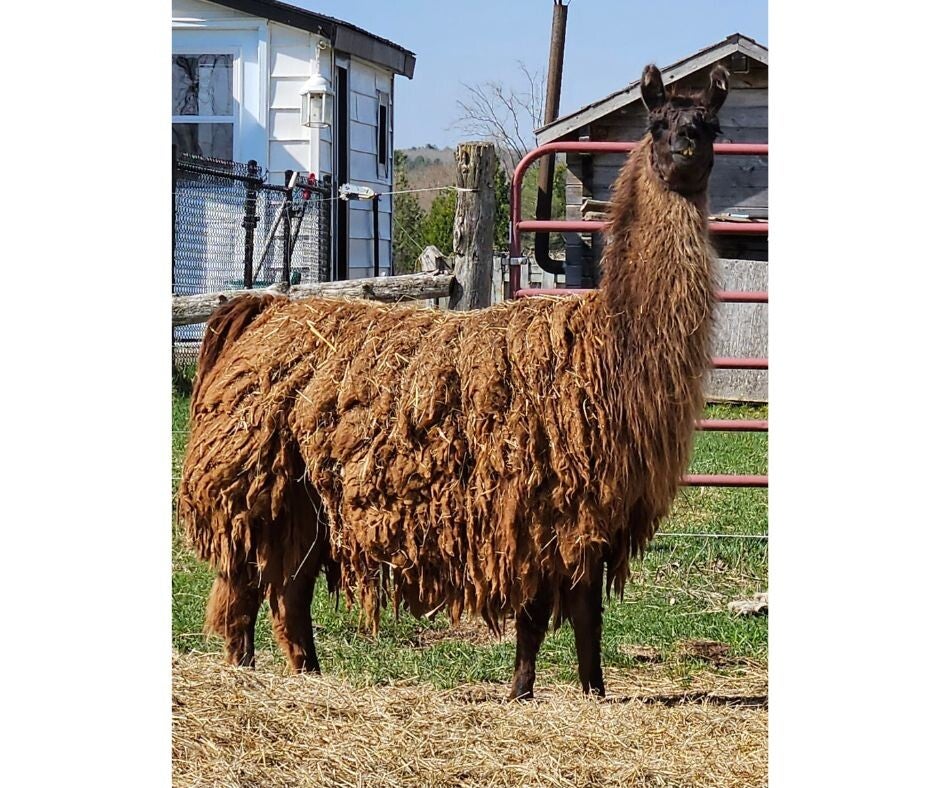
I immediately needed to fill this void, and as it happened, a local petting zoo type farm had a herd of rescued llamas for sale. I went down and randomly choose a good sized, young looking, female llama. We named her Dolly, as well; we aren't terribly imaginative with our animal names, as you can see. Anyway, there were a number of people available to help load her and off I went home. I got her home and quickly learned she was nowhere near tame. Nonetheless, we put her out with the sheep to test her out. Ever since, she has been a terrific livestock guardian, sending out audible signals when people walk their dogs by - which sends the sheep running for the barn, charging at unknown dogs in the vicinity of the herd and sleeping by the barn door at night for protection. She will bolt if anyone tries to touch her, yet she would, and still will, eat grain out of a bucket, held by one of us. However strangers, she will not go near at all.
Grooming Dolly
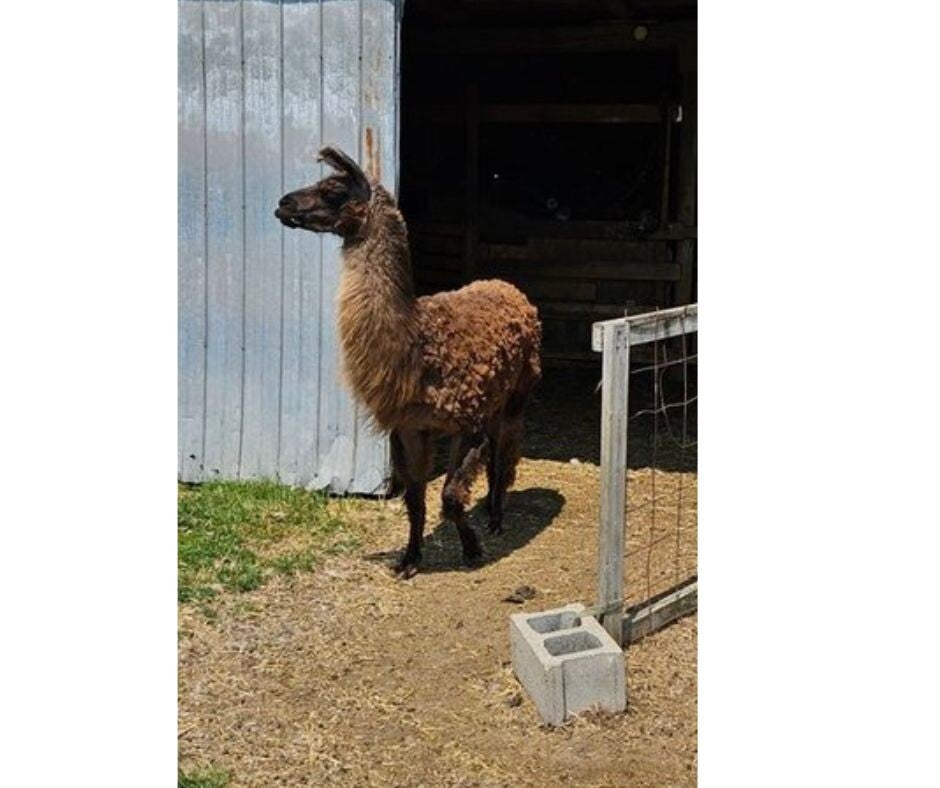
This is where the tricky part came in. We were desperate to clip Dolly's unruly coat the year after she arrived. In order to do so, I liaised with the farm veterinarian for a sedative. That was a crap shoot, because, I had no idea what she weighed under all her fiber and was panicy that I might overdose her. Furthermore, the sedative needed to be given under the tongue. So, I enlisted the help of my husband and youngest son, to lure Dolly into the barn with feed, sneak up behind her with a loose gate and pin her into a corner. We were concerned she might spit at us, and llama spit is vile, so we all wore face shields. Turns out, she never spit once. I then wrestled a pony halter on her head and tied her up. The boys kept the gate in place. I did my best to administer the sedative; likely getting most of it on her face and on myself. In the end, the sedative didn't seem to have an effect, so I went to work with the shears - reaching through the large gaps in the gate. Side one was done and we had to awkwardly turn Dolly and squeeze her with the gate to do her other side. Once that was "good enough", I attempted to trim her toenails. Llamas have two toes per foot and a large toenail on each - like a camel. In the wild these nails get trimmed naturally by rocks and hard ground. On the farm, they require trimming. I used a pair of hoof trimmers to trim them and was certain I was going to be kicked in the face at any time - so stressful. I avoided that fate, and managed to trim her front feet only, before she promptly lay her body down over her feet, thereby preventing me from any further trimming. We figured we had traumatized her, and ourselves, sufficiently for one day and let her loose. We had taken off a ton of fiber and she looked so much more comfortable. It was a huge chore, but a necessary one and one will do every other year to stay on top of it. One can hire professional groomers to come in, but due to Dolly's wild side, we wouldn't risk it, for both her wellbeing and that of the groomers!

Guardian Considerations
Before even aquiring livestock, it's a good idea to have guardianship in mind. Do you have sufficient pasture space to accomodate a guardian, do you have enough space in a shelter? Guardians consume a lot of feed, wether it's pasture, dry hay or dog food, so that must be calculated into the cost of keeping them. For donkeys and dogs, and to a lesser extent llamas, there are also vet bills to consider. Learning from our experiences, it is also a good idea to determine whether livestock guardian dogs would pose a nuissance to any neighbours.